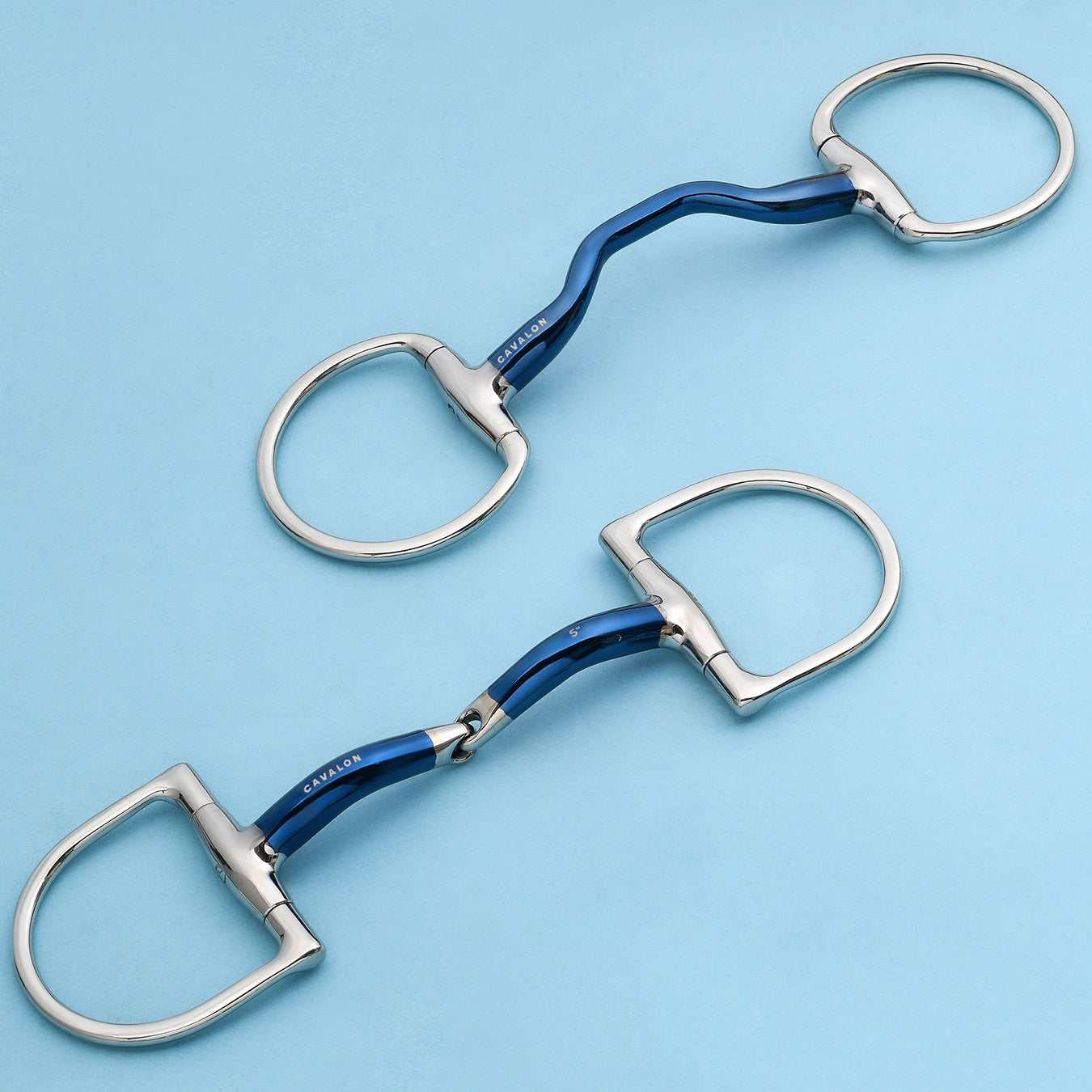
In pursuit of perfect harmony between horse and rider, every part of the bit matters, including the part most riders never think about.
Riders put real thought into a bit's mouthpiece, and then attach it to whatever cheekpiece comes with it. Yet the cheekpiece, the ring or shank on each side of the mouthpiece, is what decides how your aids actually reach your horse: how stable the contact feels, how much steering or leverage you have, and how clearly the signal travels. Whether you ride English or Western, dressage or trail, this guide walks through every cheekpiece style, what it does, how it feels, and who it's for.
The one distinction that organizes every cheekpiece: direct vs. leverage
Every cheekpiece is one of two things, and this single idea makes the rest simple:
a. Direct (snaffle) cheeks apply pressure one-to-one. When you take up a pound of rein, the mouth feels about a pound, no multiplication. The rein and bridle attach at the same point. These are your loose rings, eggbutts, D-rings, full cheeks, and bauchers.
b. Leverage (curb) cheeks use a shank. The rein attaches below the mouthpiece, the bridle above it, and a curb chain sits in the chin groove. Pulling rotates the shank, which multiplies your rein aid and adds pressure on the poll and chin. These are your shanked curbs, short shank, Argentine, S-shank, teardrop, loose shank, plus the Kimberwick and Pelham.
Neither family is "kinder" or "harsher" by default; they're different tools for different stages of training and ways of riding. Here's the whole system.
Understanding the main styles
Most snaffle cheekpieces fall into a handful of shapes, each with a different feel:
Snaffle cheekpieces (direct pressure)
Snaffle cheeks differ in just two things: how stable the bit sits, and how much steering help it gives. One of them slides; the rest are fixed.
Loose ring (the sliding style)
The mouthpiece slides freely on a full round ring, so it can move with your horse's mouth. That mobility gives a light, "alive" contact and makes it harder for a horse to lean or lock on, which is why so many dressage and schooling riders reach for a loose ring snaffle. The classic trade-off is that the moving ring can pinch lip skin at the hole, so a smooth, beveled ring opening (or bit guards) matters.
Eggbutt
An eggbutt fixes the mouthpiece to the ring with a smooth, rounded junction, so the bit stays still. That steadiness reassures a young or sensitive horse, and the closed junction is designed to prevent the pinch a loose ring can cause. The trade-off: a horse can learn to lean on something so steady. An eggbutt snaffle is a dependable, pinch-free everyday choice.
D-ring and Hunter D
The flat side of a D-shaped ring lies against the cheek and nudges the head into a turn, while keeping the bit from sliding through the mouth. That makes the D-ring snaffle a favorite for clearer steering without a big change in feel, and the Hunter D variant is presented for the show ring. More lateral help than a loose ring or eggbutt, with a steady contact.
Full cheek
Long arms above and below the mouthpiece give the strongest steering of any snaffle and completely stop the bit sliding sideways, which is why a full cheek snaffle is traditional for hunters and for starting young horses. The arms are usually paired with small bridle loops called keepers. The one thing to watch is a straight upper arm pressing against the face; a full cheek whose upper arm curves gently away from the cheek keeps the steering benefit while staying clear of sensitive skin.
Baucher
A baucher hangs the bit from a small upper attachment, so it sits exceptionally still and gives a quiet, consistent cue, popular with riders who want maximum steadiness. You'll sometimes read that it "adds no poll pressure"; in reality the baucher's poll action is debated among bitting experts, so it's best thought of simply as a very stable, quiet hanging cheek.
Curb cheekpieces (leverage)
Curb cheeks add a shank and a curb chain, turning your rein aid into a lever. Two measurements shape how a curb behaves: the purchase (the arm above the mouthpiece, where the bridle attaches, longer purchase engages the poll sooner) and the shank (the arm below, where the rein attaches, a longer shank multiplies your aid more). Most curbs also give a small pre-signal: the shank rotates slightly before full pressure arrives, quietly warning the horse a cue is coming. Curbs suit trained horses ridden with a lighter, more intermittent contact, not green horses still learning to steer.
Short (compact) shank
A short shank curb has a shorter lower arm, so it produces less leverage and a more immediate, direct response with little delay. Riders often choose it when transitioning a horse from a snaffle toward curb work, for younger or lighter-mouthed horses, and for everyday or ranch riding where a touch of poll-and-chin engagement is wanted without strong amplification.
Argentine
The Argentine curb is a moderate-length swept-back shank, frequently paired with a jointed or capsule mouthpiece. It gives moderate leverage and poll engagement with a noticeable pre-signal, which makes it a popular transition and performance bit, common when finishing a horse out of the snaffle and in general Western performance riding where the rider wants moderate control with a clear warning before pressure.
S-shank and Teardrop shank
These are shank-shape variants of the leverage idea. The S-shank's curved arm and the teardrop shank's looped lower arm change the timing and balance of how the shank rotates and where the rein settles, while delivering the same basic curb action. Riders often choose a shape by feel and by the look and balance they prefer for their discipline.
Loose shank
A loose shank lets the shanks swivel independently where they attach (much like a loose ring does on a snaffle). That bit of side-to-side independence adds a little lateral feel and pre-signal to the leverage action, useful for a horse that appreciates a softer, more "conversational" curb.
Kimberwick
A Kimberwick is a D-shaped curb cheek, usually slotted so the rein can sit in different positions for variable, mild leverage, used with a single rein and a curb chain. It's a gentle step up from a snaffle, a little poll-and-chin action with snaffle-like simplicity.
Pelham
A Pelham combines a snaffle ring and a curb shank in one mouthpiece, with two reins (or joined with leather roundings). It lets the rider call on direct or leverage action from a single bit, a versatile choice in show jumping, eventing, and polo. The trade-off is that managing two reins (or fudging it with roundings) blurs the precision of each action.
English vs. Western: how cheekpiece communication differs
The two families don't just feel different; they speak different languages.
English snaffle cheeks are built for a direct, continuous conversation. The rider usually keeps a steady contact with two hands, and the cheek shape mostly affects stability and steering. Cues are immediate and one-to-one: ask, and the mouth feels exactly that.
Western curb cheeks are built for signal and release. The horse is typically ridden on a lighter, looser rein, often one-handed with neck-reining, and the shank's pre-signal lets the horse respond to the suggestion of a cue before full pressure arrives, through the poll, chin, and bars rather than steady mouth contact. That's why a curb belongs on a finished horse that already understands the aids; the leverage refines an existing conversation rather than teaching a new one. Browse the families side by side under English bits and Western bits to see how the hardware reflects each style of riding.
Finish and feel: Sweet Iron, and Black / Silver Dotted
A cheekpiece's finish changes durability and looks (and, for the mouthpiece, taste), not its mechanical action.
- Sweet iron mouthpieces oxidize to a mild, sweet-tasting surface that many horses salivate to and accept readily; the light surface rust that develops is normal for the material, not a flaw.
- Black and silver-dotted cheekpieces use a PVD titanium coating bonded over stainless steel rather than rust-prone black iron, for a deep, durable black that resists chipping, sweat, and saliva. The silver-dot detailing is an aesthetic accent within that line. The coating is about durability and appearance; it doesn't change how the bit acts in the mouth.
A note on mouthpiece mechanisms: you'll see names like "Capsule Link" and "Pivot Link" on Cavalon products. Those describe the mouthpiece center, how the middle of the bit articulates to manage tongue pressure and signal, not the cheekpiece. They pair with many of the cheek styles above, so think of mouthpiece mechanism and cheekpiece as two separate choices you combine.
How cheekpiece design affects comfort and communication
Within any style, the details of the cheek decide how comfortable and clear the bit really is, worth understanding whatever you ride:
- Clearance from the face. Rings and arms that curve gently away from the face keep metal off sensitive skin during turns and lateral work, a real difference for thin-skinned horses.
- A quiet, smooth hinge. A loose, rattly joint can pinch the corner of the lip and adds a flicker of delay; a tight, smooth hinge stays quiet and lets the cue arrive when you ask.
- A consistent rein position. A ring shaped to give the rein a natural low point keeps your contact in the same place, so cues stay repeatable.
- Light, strong construction. A lighter cheek is one the horse can carry rather than brace against, best achieved by precise shaping, not by making the bit weaker.
This is simply good cheekpiece engineering applied consistently, the philosophy Cavalon builds around across both its snaffle and curb lines.
Matching the cheekpiece to your discipline and your horse
Your discipline, your goals, and your individual horse all shape the right choice. Some starting points (and if you compete, always confirm permitted bits in your association's current rulebook; bit rules vary by level and discipline):
- Dressage: loose ring and eggbutt snaffles are everyday workhorses; some riders use a baucher for steadiness. Check USEF/USDF rules before showing.
- Hunters & jumpers: D-rings and full cheeks are traditional in the hunter ring; loose rings and eggbutts are common in jumpers; Pelhams appear in some jumper and equitation contexts.
- Eventing: needs vary across the three phases, and the dressage phase has its own bit rules.
- Western disciplines: young horses start in a snaffle (often eggbutt, D-ring, or full cheek), then progress to a curb; a short shank or Argentine is a common first leverage bit, with longer or shaped shanks as the horse finishes.
- Trail & pleasure: comfort and a steady contact usually win, eggbutt and D-ring snaffles, or a mild short shank for a horse that goes well in a little leverage.
- Starting young horses: stability and clear steering matter most, so eggbutts, D-rings, and full cheeks are popular; many riders move to a loose ring as the horse softens.
(Bits are sized in inches across the mouthpiece in the U.S. and most English-speaking markets, usually in quarter-inch steps; elsewhere you may see millimetres.)
How to choose, and how to get the size right
Work through it in order. First, direct or leverage? A horse still learning, or one you ride on steady two-handed contact, wants a snaffle; a finished horse ridden lightly or one-handed can move to a curb. Second, within the family, stability vs. steering (for snaffles) or how much leverage (for curbs: shorter and swept-back shanks are milder and more immediate; longer shanks amplify more). Third, weigh comfort details: for a sensitive face, favor face-away rings and a smooth hinge.
Then get the size right, because fit matters as much as style: too wide and the bit slides and loses its steering benefit; too narrow and it pinches. If you're not sure where to start, Cavalon's Bit Quiz walks you to a suitable style and size, and every bit is backed by a lifetime warranty, so you can decide with confidence.
The right cheekpiece doesn't announce itself. It simply gets out of the way, so the only thing left between you and your horse is the conversation.
Frequently asked questions
What is a cheekpiece on a horse bit?
It's the side of the bit, the ring or shank on each end of the mouthpiece, where the reins and bridle attach. It holds the mouthpiece in place and shapes how your rein pressure reaches your horse.
What's the difference between a snaffle and a curb?
A snaffle cheek applies direct, one-to-one pressure. A curb cheek uses a shank and curb chain to create leverage, multiplying the rein aid and adding poll and chin pressure. Snaffles suit horses in training; curbs suit finished horses ridden lightly.
Are shorter shanks milder than longer ones?
Generally, yes. A shorter shank is a shorter lever, so it produces less leverage and a more immediate response. Riders often choose short shanks for transitioning horses or everyday riding that wants only mild leverage.
What is an Argentine bit used for?
The Argentine is a moderate swept-back shank curb, often with a jointed mouthpiece. It gives moderate leverage with a clear pre-signal, making it a popular transition bit and a common choice in Western performance riding.
How do English and Western cheekpieces communicate differently?
English snaffles work through direct, continuous two-handed contact. Western curbs work through signal-and-release on a lighter rein, often one-handed, with the shank's pre-signal warning the horse before full pressure, which is why curbs belong on trained horses.
Do Cavalon's black bits rust?
No. The black and silver-dotted cheekpieces use a PVD titanium coating over stainless steel rather than black iron, so they resist rust and chipping. (Sweet iron mouthpieces are meant to oxidize for taste; the coated cheekpieces stay black.)
Does a baucher add poll pressure?
It's debated. A baucher hangs the bit so it sits very still and gives a quiet, consistent cue; whether it meaningfully engages the poll is disagreed upon among bitting experts, so treat it as a stability-focused cheek.
How do I choose the right size?
Bit size is the mouthpiece width, usually in quarter-inch steps. Measure a bit your horse already wears comfortably and match the width, or use Cavalon's Bit Quiz to land on a style and size if you're starting fresh.
The right bit is the one that fits your horse and your goals; whatever you ride, we're glad to help you think it through.
In pursuit of perfect harmony between horse and rider, every part of the bit matters, including the part most riders never think about.
Riders put real thought into a bit's mouthpiece, and then attach it to whatever cheekpiece comes with it. Yet the cheekpiece, the ring or shank on each side of the mouthpiece, is what decides how your aids actually reach your horse: how stable the contact feels, how much steering or leverage you have, and how clearly the signal travels. Whether you ride English or Western, dressage or trail, this guide walks through every cheekpiece style, what it does, how it feels, and who it's for.
The one distinction that organizes every cheekpiece: direct vs. leverage
Every cheekpiece is one of two things, and this single idea makes the rest simple:
a. Direct (snaffle) cheeks apply pressure one-to-one. When you take up a pound of rein, the mouth feels about a pound, no multiplication. The rein and bridle attach at the same point. These are your loose rings, eggbutts, D-rings, full cheeks, and bauchers.
b. Leverage (curb) cheeks use a shank. The rein attaches below the mouthpiece, the bridle above it, and a curb chain sits in the chin groove. Pulling rotates the shank, which multiplies your rein aid and adds pressure on the poll and chin. These are your shanked curbs, short shank, Argentine, S-shank, teardrop, loose shank, plus the Kimberwick and Pelham.
Neither family is "kinder" or "harsher" by default; they're different tools for different stages of training and ways of riding. Here's the whole system.
Understanding the main styles
Most snaffle cheekpieces fall into a handful of shapes, each with a different feel:
Snaffle cheekpieces (direct pressure)
Snaffle cheeks differ in just two things: how stable the bit sits, and how much steering help it gives. One of them slides; the rest are fixed.
Loose ring (the sliding style)
The mouthpiece slides freely on a full round ring, so it can move with your horse's mouth. That mobility gives a light, "alive" contact and makes it harder for a horse to lean or lock on, which is why so many dressage and schooling riders reach for a loose ring snaffle. The classic trade-off is that the moving ring can pinch lip skin at the hole, so a smooth, beveled ring opening (or bit guards) matters.
Eggbutt
An eggbutt fixes the mouthpiece to the ring with a smooth, rounded junction, so the bit stays still. That steadiness reassures a young or sensitive horse, and the closed junction is designed to prevent the pinch a loose ring can cause. The trade-off: a horse can learn to lean on something so steady. An eggbutt snaffle is a dependable, pinch-free everyday choice.
D-ring and Hunter D
The flat side of a D-shaped ring lies against the cheek and nudges the head into a turn, while keeping the bit from sliding through the mouth. That makes the D-ring snaffle a favorite for clearer steering without a big change in feel, and the Hunter D variant is presented for the show ring. More lateral help than a loose ring or eggbutt, with a steady contact.
Full cheek
Long arms above and below the mouthpiece give the strongest steering of any snaffle and completely stop the bit sliding sideways, which is why a full cheek snaffle is traditional for hunters and for starting young horses. The arms are usually paired with small bridle loops called keepers. The one thing to watch is a straight upper arm pressing against the face; a full cheek whose upper arm curves gently away from the cheek keeps the steering benefit while staying clear of sensitive skin.
Baucher
A baucher hangs the bit from a small upper attachment, so it sits exceptionally still and gives a quiet, consistent cue, popular with riders who want maximum steadiness. You'll sometimes read that it "adds no poll pressure"; in reality the baucher's poll action is debated among bitting experts, so it's best thought of simply as a very stable, quiet hanging cheek.
Curb cheekpieces (leverage)
Curb cheeks add a shank and a curb chain, turning your rein aid into a lever. Two measurements shape how a curb behaves: the purchase (the arm above the mouthpiece, where the bridle attaches, longer purchase engages the poll sooner) and the shank (the arm below, where the rein attaches, a longer shank multiplies your aid more). Most curbs also give a small pre-signal: the shank rotates slightly before full pressure arrives, quietly warning the horse a cue is coming. Curbs suit trained horses ridden with a lighter, more intermittent contact, not green horses still learning to steer.
Short (compact) shank
A short shank curb has a shorter lower arm, so it produces less leverage and a more immediate, direct response with little delay. Riders often choose it when transitioning a horse from a snaffle toward curb work, for younger or lighter-mouthed horses, and for everyday or ranch riding where a touch of poll-and-chin engagement is wanted without strong amplification.
Argentine
The Argentine curb is a moderate-length swept-back shank, frequently paired with a jointed or capsule mouthpiece. It gives moderate leverage and poll engagement with a noticeable pre-signal, which makes it a popular transition and performance bit, common when finishing a horse out of the snaffle and in general Western performance riding where the rider wants moderate control with a clear warning before pressure.
S-shank and Teardrop shank
These are shank-shape variants of the leverage idea. The S-shank's curved arm and the teardrop shank's looped lower arm change the timing and balance of how the shank rotates and where the rein settles, while delivering the same basic curb action. Riders often choose a shape by feel and by the look and balance they prefer for their discipline.
Loose shank
A loose shank lets the shanks swivel independently where they attach (much like a loose ring does on a snaffle). That bit of side-to-side independence adds a little lateral feel and pre-signal to the leverage action, useful for a horse that appreciates a softer, more "conversational" curb.
Kimberwick
A Kimberwick is a D-shaped curb cheek, usually slotted so the rein can sit in different positions for variable, mild leverage, used with a single rein and a curb chain. It's a gentle step up from a snaffle, a little poll-and-chin action with snaffle-like simplicity.
Pelham
A Pelham combines a snaffle ring and a curb shank in one mouthpiece, with two reins (or joined with leather roundings). It lets the rider call on direct or leverage action from a single bit, a versatile choice in show jumping, eventing, and polo. The trade-off is that managing two reins (or fudging it with roundings) blurs the precision of each action.
English vs. Western: how cheekpiece communication differs
The two families don't just feel different; they speak different languages.
English snaffle cheeks are built for a direct, continuous conversation. The rider usually keeps a steady contact with two hands, and the cheek shape mostly affects stability and steering. Cues are immediate and one-to-one: ask, and the mouth feels exactly that.
Western curb cheeks are built for signal and release. The horse is typically ridden on a lighter, looser rein, often one-handed with neck-reining, and the shank's pre-signal lets the horse respond to the suggestion of a cue before full pressure arrives, through the poll, chin, and bars rather than steady mouth contact. That's why a curb belongs on a finished horse that already understands the aids; the leverage refines an existing conversation rather than teaching a new one. Browse the families side by side under English bits and Western bits to see how the hardware reflects each style of riding.
Finish and feel: Sweet Iron, and Black / Silver Dotted
A cheekpiece's finish changes durability and looks (and, for the mouthpiece, taste), not its mechanical action.
- Sweet iron mouthpieces oxidize to a mild, sweet-tasting surface that many horses salivate to and accept readily; the light surface rust that develops is normal for the material, not a flaw.
- Black and silver-dotted cheekpieces use a PVD titanium coating bonded over stainless steel rather than rust-prone black iron, for a deep, durable black that resists chipping, sweat, and saliva. The silver-dot detailing is an aesthetic accent within that line. The coating is about durability and appearance; it doesn't change how the bit acts in the mouth.
A note on mouthpiece mechanisms: you'll see names like "Capsule Link" and "Pivot Link" on Cavalon products. Those describe the mouthpiece center, how the middle of the bit articulates to manage tongue pressure and signal, not the cheekpiece. They pair with many of the cheek styles above, so think of mouthpiece mechanism and cheekpiece as two separate choices you combine.
How cheekpiece design affects comfort and communication
Within any style, the details of the cheek decide how comfortable and clear the bit really is, worth understanding whatever you ride:
- Clearance from the face. Rings and arms that curve gently away from the face keep metal off sensitive skin during turns and lateral work, a real difference for thin-skinned horses.
- A quiet, smooth hinge. A loose, rattly joint can pinch the corner of the lip and adds a flicker of delay; a tight, smooth hinge stays quiet and lets the cue arrive when you ask.
- A consistent rein position. A ring shaped to give the rein a natural low point keeps your contact in the same place, so cues stay repeatable.
- Light, strong construction. A lighter cheek is one the horse can carry rather than brace against, best achieved by precise shaping, not by making the bit weaker.
This is simply good cheekpiece engineering applied consistently, the philosophy Cavalon builds around across both its snaffle and curb lines.
Matching the cheekpiece to your discipline and your horse
Your discipline, your goals, and your individual horse all shape the right choice. Some starting points (and if you compete, always confirm permitted bits in your association's current rulebook; bit rules vary by level and discipline):
- Dressage: loose ring and eggbutt snaffles are everyday workhorses; some riders use a baucher for steadiness. Check USEF/USDF rules before showing.
- Hunters & jumpers: D-rings and full cheeks are traditional in the hunter ring; loose rings and eggbutts are common in jumpers; Pelhams appear in some jumper and equitation contexts.
- Eventing: needs vary across the three phases, and the dressage phase has its own bit rules.
- Western disciplines: young horses start in a snaffle (often eggbutt, D-ring, or full cheek), then progress to a curb; a short shank or Argentine is a common first leverage bit, with longer or shaped shanks as the horse finishes.
- Trail & pleasure: comfort and a steady contact usually win, eggbutt and D-ring snaffles, or a mild short shank for a horse that goes well in a little leverage.
- Starting young horses: stability and clear steering matter most, so eggbutts, D-rings, and full cheeks are popular; many riders move to a loose ring as the horse softens.
(Bits are sized in inches across the mouthpiece in the U.S. and most English-speaking markets, usually in quarter-inch steps; elsewhere you may see millimetres.)
How to choose, and how to get the size right
Work through it in order. First, direct or leverage? A horse still learning, or one you ride on steady two-handed contact, wants a snaffle; a finished horse ridden lightly or one-handed can move to a curb. Second, within the family, stability vs. steering (for snaffles) or how much leverage (for curbs: shorter and swept-back shanks are milder and more immediate; longer shanks amplify more). Third, weigh comfort details: for a sensitive face, favor face-away rings and a smooth hinge.
Then get the size right, because fit matters as much as style: too wide and the bit slides and loses its steering benefit; too narrow and it pinches. If you're not sure where to start, Cavalon's Bit Quiz walks you to a suitable style and size, and every bit is backed by a lifetime warranty, so you can decide with confidence.
The right cheekpiece doesn't announce itself. It simply gets out of the way, so the only thing left between you and your horse is the conversation.
Frequently asked questions
What is a cheekpiece on a horse bit?
It's the side of the bit, the ring or shank on each end of the mouthpiece, where the reins and bridle attach. It holds the mouthpiece in place and shapes how your rein pressure reaches your horse.
What's the difference between a snaffle and a curb?
A snaffle cheek applies direct, one-to-one pressure. A curb cheek uses a shank and curb chain to create leverage, multiplying the rein aid and adding poll and chin pressure. Snaffles suit horses in training; curbs suit finished horses ridden lightly.
Are shorter shanks milder than longer ones?
Generally, yes. A shorter shank is a shorter lever, so it produces less leverage and a more immediate response. Riders often choose short shanks for transitioning horses or everyday riding that wants only mild leverage.
What is an Argentine bit used for?
The Argentine is a moderate swept-back shank curb, often with a jointed mouthpiece. It gives moderate leverage with a clear pre-signal, making it a popular transition bit and a common choice in Western performance riding.
How do English and Western cheekpieces communicate differently?
English snaffles work through direct, continuous two-handed contact. Western curbs work through signal-and-release on a lighter rein, often one-handed, with the shank's pre-signal warning the horse before full pressure, which is why curbs belong on trained horses.
Do Cavalon's black bits rust?
No. The black and silver-dotted cheekpieces use a PVD titanium coating over stainless steel rather than black iron, so they resist rust and chipping. (Sweet iron mouthpieces are meant to oxidize for taste; the coated cheekpieces stay black.)
Does a baucher add poll pressure?
It's debated. A baucher hangs the bit so it sits very still and gives a quiet, consistent cue; whether it meaningfully engages the poll is disagreed upon among bitting experts, so treat it as a stability-focused cheek.
How do I choose the right size?
Bit size is the mouthpiece width, usually in quarter-inch steps. Measure a bit your horse already wears comfortably and match the width, or use Cavalon's Bit Quiz to land on a style and size if you're starting fresh.
The right bit is the one that fits your horse and your goals; whatever you ride, we're glad to help you think it through.